
On 26 November 2026, Grisebach will auction A Mermaid by the Polish-Danish painter Elisabeth Jerichau-Baumann (1819–1881). Equally remarkable is its unusual frame, presumably designed specifically for the painting.

Elisabeth Jerichau-Baumann, A Mermaid, 1847/61, in its extraordinary frame
The broad, flat panel is gilded in a cool shade of gold and decorated with the classical ‘running dog’ ornament. Unusually, the ornament is arranged symmetrically towards the centre of each frame rail. Large sculpted shell ornaments in the corners echo the marine subject of the painting.
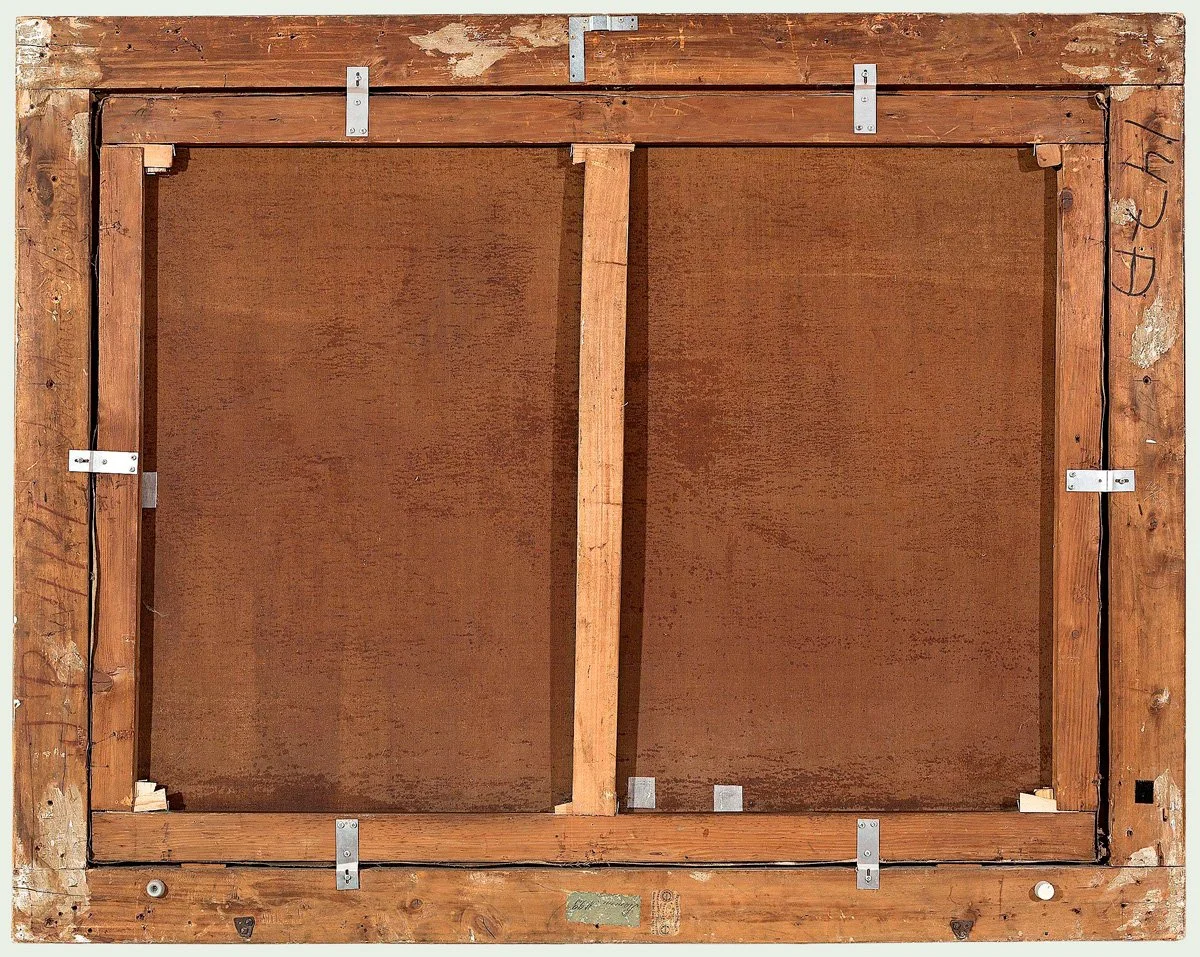
Reverse of the frame showing the butt-joined corners
The butt joints at the corners are clearly visible on the reverse. Two labels have also survived. The workshop label identifies the Roman framemaker Francesco Somasca, who describes himself as “Doratore, Verniciatore, Intagliatore” – gilder, varnisher and woodcarver. Two medallions refer to the exhibitions “Esp. Romana” of 1870 and “Esp. Nazionale” of 1871.
Somasca is documented as early as 1855 in the Almanacco Romano, at Via del Corso 480, the address also given on the label.
The connection with Rome is unsurprising: Jerichau-Baumann lived there for several years from 1845, married the Danish sculptor Jens Adolf Jerichau in 1846 and returned to the city on numerous occasions.
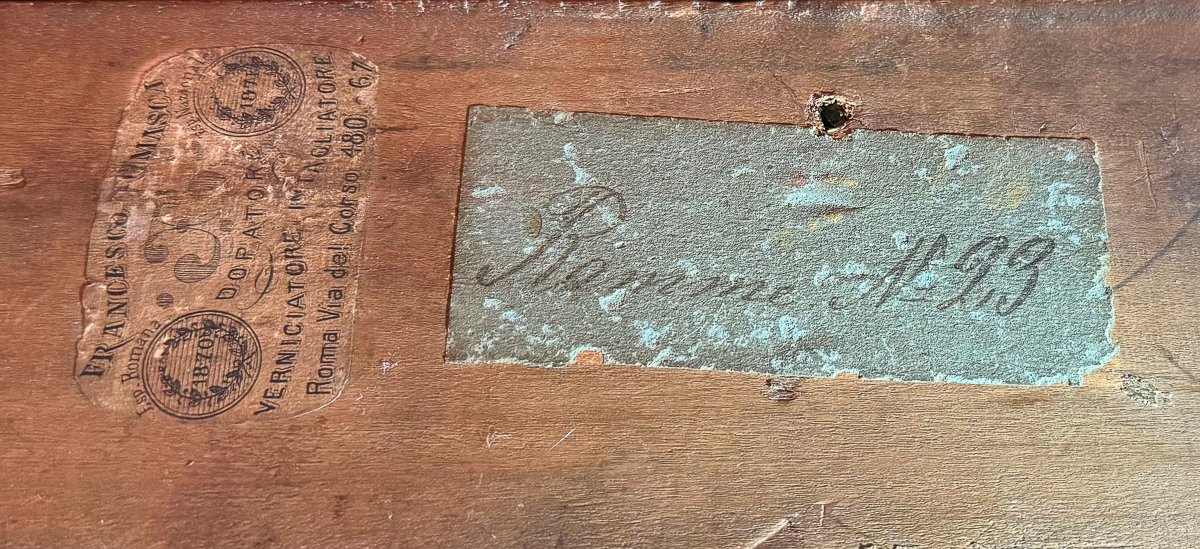
Workshop label of Francesco Somasca and handwritten inscription “Ramme No. 23”
The second label bears the handwritten inscription “Ramme No. 23” – Danish for “Frame No. 23”. The inscription may even be in the artist’s own hand.
One question, however, remains unresolved: the painting was purchased directly from the artist by the Danish collector Wanda Zahrtmann in 1861. Yet the workshop label, with its exhibition medals, cannot date from before 1871. When the frame was actually made and when it was fitted to the painting remain uncertain.
The mermaid was a subject to which the artist returned over many years, as demonstrated by another version from 1873 in the Ny Carlsberg Glyptotek in Copenhagen, which has a more traditional frame typical of the period.
Two further paintings reveal Jerichau-Baumann’s preference for extraordinary frames: Harem Woman of 1871 in the Lund University Art Collection and Head of a Woman of 1874 in the Göteborgs konstmuseum. Their strikingly similar frames feature a broad flat surface with pointed leaf ornaments, a twisted outer moulding and an inner beaded moulding.
These distinctive and unconventional frames suggest that Jerichau-Baumann attached particular importance to the framing of her works.
Werner Murrer
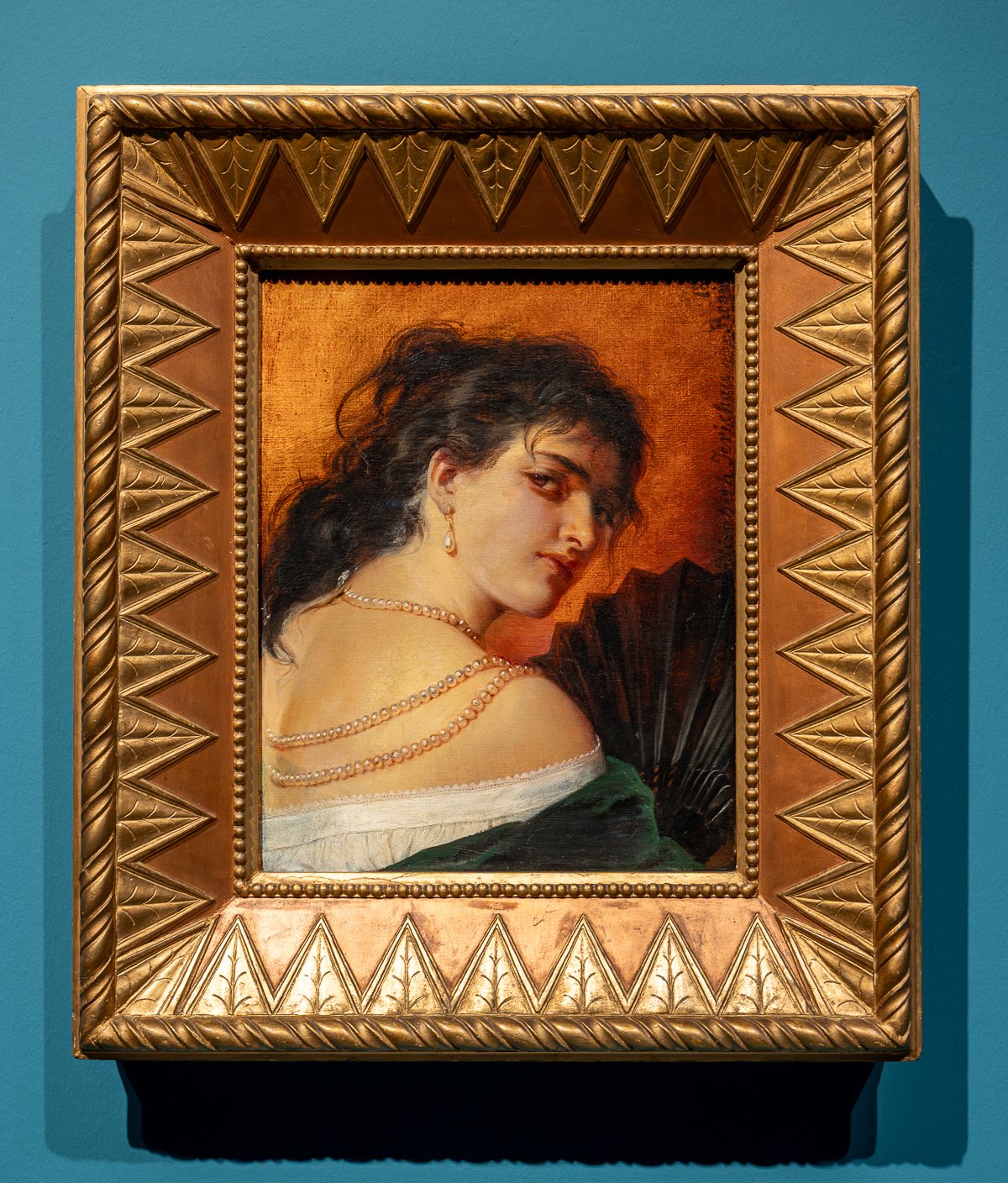
Elisabeth Jerichau-Baumann, Head of a Woman, 1874, Göteborgs konstmuseum
Photo credits
Photographs: Christian Kain (cover image), Grisebach (figs. 1–3), Werner Murrer (fig. 4)